
choosing the right racket
Shape, material, weight, texture and balance all play a crucial role in defining how a racket performs. Here's all the info you need to choose the right racket for you.

shape

Round
More control and a larger sweet spot – A round-shaped padel racket is a great choice for beginners or players who value control. Its centrally positioned, oversized sweet spot makes it easier to manoeuvre and more forgiving on off-centre hits, helping build confidence and consistency

Teardrop
Balanced power and control – A teardrop-shaped racket offers a well-balanced mix of power and control. With the sweet spot positioned slightly higher than in round rackets, they provide a mix of control and attacking potential. This shape suits intermediate players developing both defensive stability and offensive flair. Ideal for beginners or defensive players who prioritise consistency over raw power.

Diamond
Maximum power but hard to control – Diamond-shaped rackets are built for advanced, aggressive players who thrive on power. The sweet spot is smaller and located near the top of the racket, requiring greater accuracy and refined technique. When struck well, these rackets deliver explosive smashes and high-impact volleys – perfect for those who dominate at the net.
material
Another key factor to consider when choosing a padel racket is the material it’s made from. The frame and face of a racket are typically either carbon fibre or fibreglass. The racket core is usually made of either foam or EVA.
Carbon Fibre
Carbon fibre padel rackets are stiffer, lighter, and more durable, offering superior control and precision. The extra rigidity ensures excellent energy transfer, making it ideal for advanced players seeking accuracy and long‑term performance. While it does come at a higher cost, it rewards with longevity and professional‑level responsiveness.
Fibreglass
Fibreglass rackets are softer, more flexible, and budget‑friendly, delivering comfort and power for beginners. Absorbing vibrations, they provide a forgiving feel that suits recreational play. Though less durable, it remains accessible and easier to handle.

Foam
Foam (polyethylene foam) offers superior comfort and shock absorption, reducing vibrations and easing strain on the arm. This makes it ideal for beginners, casual players, or those recovering from injury. While it enhances playability and feel, it tends to wear out faster and offers slightly less control and power compared to EVA.
EVA
EVA (ethylene-vinyl acetate) is a firmer, more resilient material that delivers a balanced mix of power and control. Its solid feel allows for precise shot-making and durability over time, making it a popular choice for intermediate and advanced players.
Balance
Balance refers to the distribution of weight across the racket. There are three main balance types:
Low (head light)
With most of the weight concentrated near the handle, this balance offers superior manoeuvrability and control. Commonly found in round-shaped rackets.
Middle (even)
Weight is spread evenly across the racket, providing a versatile blend of power and control. This neutral balance suits all-round players and is typically found in teardrop-shaped rackets.
Top (head heavy)
The weight is focused in the racket’s head, delivering maximum power on impact. While this setup boosts shot speed, it’s less agile and demands solid technique. Most often featured in diamond-shaped rackets.
weight
One of the most important decisions when choosing a padel racket is weight. Rackets typically weigh between 340 grams and 390 grams.
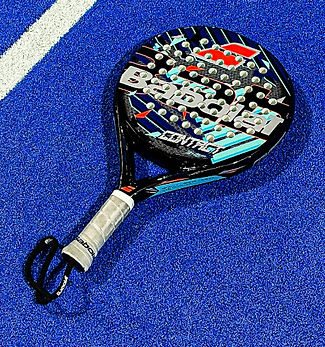
Lighter Rackets
(365g and below)
Faster swing.
More manoeuvrability.
Less strain on the arm.
Ideal for beginner & control-focused players.
Heavier Rackets
(365g and above)
More power, especially on smashes.
More stability on impact.
Ideal for experienced & attacking players.
For players who may be susceptible to tennis elbow or have existing arm or shoulder issues a lighter racket is definetely the way to go.
surface texture
The texture of a padel racket’s surface plays a subtle but impactful role in shaping your game. It influences how much spin you can generate and how the ball behaves after contact.
Smooth
Smooth-faced rackets offer a clean, predictable ball trajectory, making them ideal for players who value stability and straightforward control. Beginners often prefer this surface, as it simplifies shot execution and reduces the variables involved in spin-heavy play.
Rough or moulded texture
Rackets with a textured surface – whether sandpaper-like or featuring raised patterns – provide enhanced grip on the ball, allowing for greater spin manipulation. This added friction helps advanced players execute technical shots like slices, drop shots, and topspin smashes with precision. The ability to create more effective spin can be a game-changer at higher levels of competition.
What's with the holes?
The holes reduce weight and air resistance, which makes the racket lighter, more manoeuvrable, and faster to swing. The holes also improve performance by helping to absorb vibration for better feel and control, and they can increase spin on the ball by altering its flight path. The number, size, and placement of the holes are strategically designed by manufacturers to influence a racket’s flexibility, power, and control to suit different playing styles.